
Metacognition means knowing how you think, and managing how you think. It is not a buzzword, a reflective journal or a personality trait. It is a set of skills, and like any skill it can be taught and practised.
It has two halves. Metacognitive knowledge is knowing: about the task, the strategies available and yourself. Metacognitive regulation is doing: planning, monitoring and evaluating your own work. One without the other does not work.
| Knowing | Doing |
|---|---|
| 1. Task knowledge | 4. Planning, before the task |
| 2. Strategy knowledge | 5. Monitoring, during it |
| 3. Person knowledge | 6. Evaluating, after it |
Knowing: the task, the strategy, yourself
Before a student can manage their learning, they need accurate knowledge of three things.
- 1. Task knowledge
- What does this task involve? What skills does it need, and how long should it take? Many students mistake familiarity for mastery: they recognise a page in the textbook and assume they can recall it in the exam. Accurate task knowledge turns a vague worry into something they can measure.
- 2. Strategy knowledge
- Which strategy fits, and when? Knowing that revision techniques exist is not enough. Does the student know when retrieval practice beats re-reading, how to break a long essay into parts, and how to switch when a strategy is not working? Having tools is one thing. Knowing when and how to use them is another.
- 3. Person knowledge
- What am I like at this? How strong am I in this subject, how long do I usually take, and what tends to trip me up? Some students underestimate their ability. Others overestimate their speed. Accurate self-knowledge lets them set realistic goals and choose strategies that fit.
Doing: plan, monitor, evaluate
If knowledge is knowing, regulation is doing: the active management of thinking before, during and after a task.
- 4. Planning
- Before the task. What does it need, which strategies will I use, how much time will I give it, and what will success look like? Planning turns a vague, overwhelming assignment into a sequence of steps.
- 5. Monitoring
- During the task. Am I understanding this? Is this strategy working? Do I need to slow down or ask for help? Monitoring stops a student spending 40 minutes on a strategy that is clearly not working.
- 6. Evaluating
- After the task. What worked, what wasted time, and what will I do differently next time? Evaluating closes the loop between one task and the next. Without it, the same mistakes repeat.
Without monitoring, effort becomes blind effort.
Why it matters
Independence rarely appears on its own, yet we often assume it will. These six elements are seldom taught explicitly, and students who fall behind are often short of strategy, not ability.
When the six are taught clearly, practised often and used across subjects, students begin to understand how they learn, not only what they learn. Once a student understands how they think, independence stops being accidental. It becomes predictable.
Where it shows up in Veyra
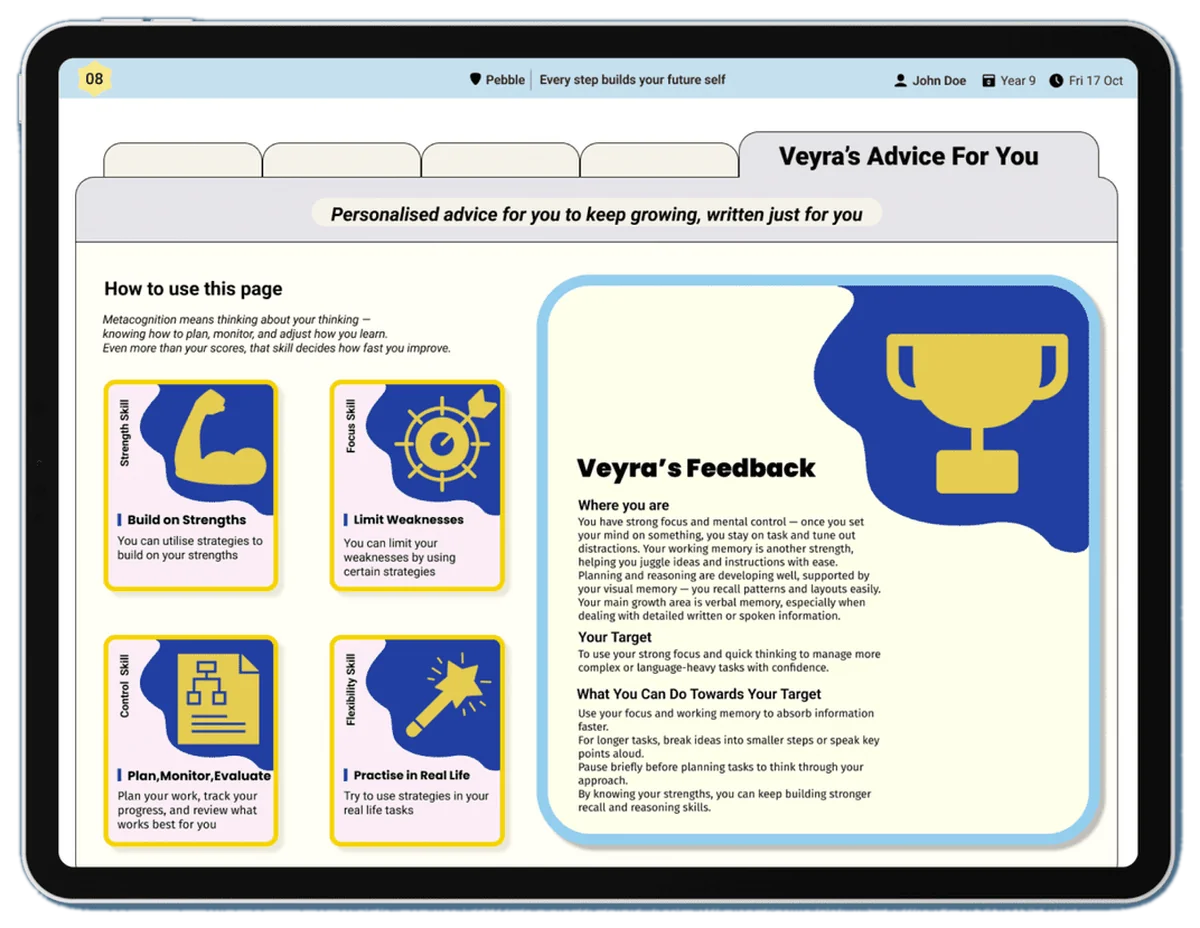
Every Student Report ends with Veyra's advice, written to the student. It explains metacognition in their terms and turns their results into next steps: build on strengths, limit what holds them back, plan, monitor and evaluate, and practise in real life (Fig. 1).
Veyra: Pebble Academy, our training game, is in development and will build the same loop into play. Before each lesson task, students will estimate how long it will take, how hard it will be and which strategies to use. Afterwards, they will compare the result with their estimate and see which strategies paid off.