
In brief
- Cognitive remediation is structured training for cognitive skills such as attention, working memory and planning.
- It is usually delivered one to one by a therapist, which does not scale to schools.
- Skills are more likely to carry over to everyday life when students reflect on the strategies they use. That idea shapes Pebble Academy.
What cognitive remediation is
Cognitive remediation is a structured intervention that aims to improve core cognitive skills, such as attention, working memory, planning, reasoning and metacognition. The goal is not only better scores on training tasks, but better functioning in everyday life.
It comes from clinical practice, where a trained therapist usually delivers it one to one. The therapist helps the person understand their difficulties, set goals, apply strategies, track progress and adjust. Programmes typically combine seven ingredients:
- Structured cognitive exercises
- Repeated practice
- Difficulty that adapts to the person
- Feedback as they go
- Building strategies
- Time to reflect
- Support to use the skills in everyday life
The scale problem
Therapist-led remediation works well in clinical settings, but it does not scale easily. It needs trained professionals, time and money, and access is limited. For schools that already face long waits for specialist support, that is a bottleneck.
Digital training tries to solve this, with mixed results. Students often improve on tasks that look like the training, known as near transfer. Gains that carry over to everyday life, known as far transfer, are less consistent.
The question is not whether digital training works at all. It is how to design it so that skills carry over.
Where metacognition comes in
Metacognition is thinking about thinking: noticing when you are struggling, choosing a strategy, checking whether it is working and adjusting. It is not only awareness. It is strategic control.
In a therapist-led programme, much of the therapist's work is this part: helping the person reflect on what they did, and coaching the strategies that worked. Many digital tools leave it out and rely on practice alone. Our view is that training is more likely to carry over when reflection and strategy use are built in.
How people learn, not only how much
Newer research looks beyond average before-and-after gains to how people learn during training: how quickly they improve, how steady their performance is, and how they engage. Two students can complete the same number of sessions and follow very different paths. One improves steadily. Another swings from session to session.
Those patterns are signals. A system that tracks them can adjust difficulty and pacing for each person, instead of giving everyone the same dose.
Why adolescence matters
In adolescence, these skills are still developing. Self-regulation is still settling and study habits are still forming, just as academic demands rise sharply. That makes it a time of both risk and opportunity, and a strong case for support that can reach every student and is grounded in evidence.
How this shapes Pebble Academy
Veyra: Pebble Academy is our training game. It is in development (pre-alpha), and it is designed to carry the procedures a therapist would use into structured play. When it rolls out, it will be part of the support for pupils who need more:
- Starts from measurement
- Training will target the skills each student's Mind Skills Check flagged, measured against national UK norms. The research behind the measures is on our evidence page.
- Adaptive challenge
- Difficulty will adjust as students play, so tasks stay achievable enough to keep going and demanding enough to build skill.
- Strategies
- Students will collect, practise and level up strategy cards (Fig. 1).
- Reflection
- Before each lesson task, students will estimate how long it will take, how hard it will be and which strategies to use, then compare the result with their estimate.
- Progress
- Teachers will see sessions completed and skills practised in the Teacher Dashboard.
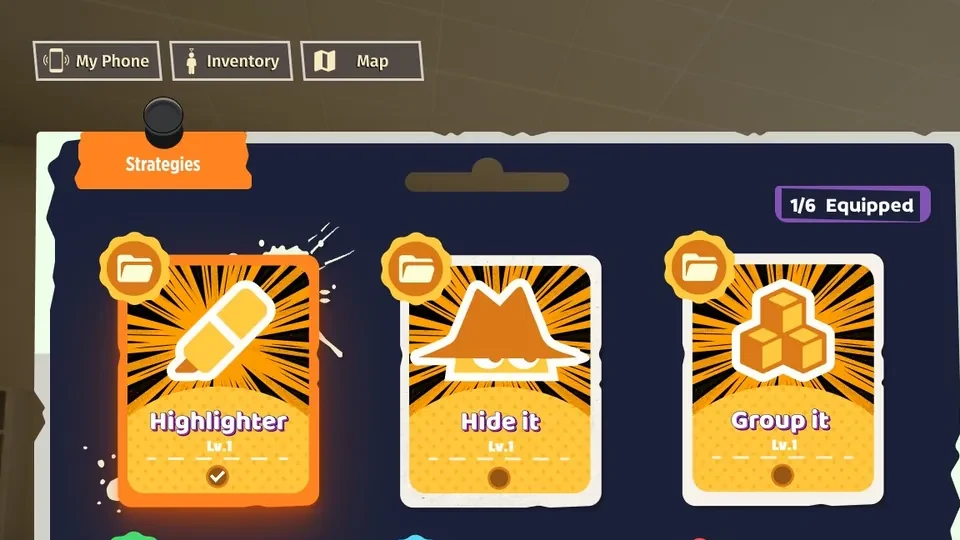
The goal is not to replace expertise. It is to keep the principles intact while depending less on scarce specialist time. Like any new intervention, Pebble Academy will need to be evaluated.
The bigger question
Cognitive remediation is not about making students try harder. It is about strengthening the skills that let effort turn into progress. The field is moving from asking whether training works on average to asking for whom, under what conditions and why. Those are the questions we are designing around.