In brief
- Attention difficulties are rarely one thing. They can start in focus, thinking or memory.
- Each area has its own signs in class, and its own adjustments.
- Knowing which area is involved turns generic support into precise support.
When a student appears distracted or disengaged, the assumption is often simple: they need to try harder. In practice, attention difficulties are rarely one-dimensional.
Veyra groups 12 cognitive skills into three areas: focus, thinking and memory. A difficulty in any of them can look like “not paying attention” from the front of the room. Knowing which one is involved changes what will help.
Three areas, three kinds of difficulty
Focus
When attention itself is the struggle
You might see a student who falls behind during fast explanations, drifts when the room is busy, calls out, or loses the thread when the activity changes.
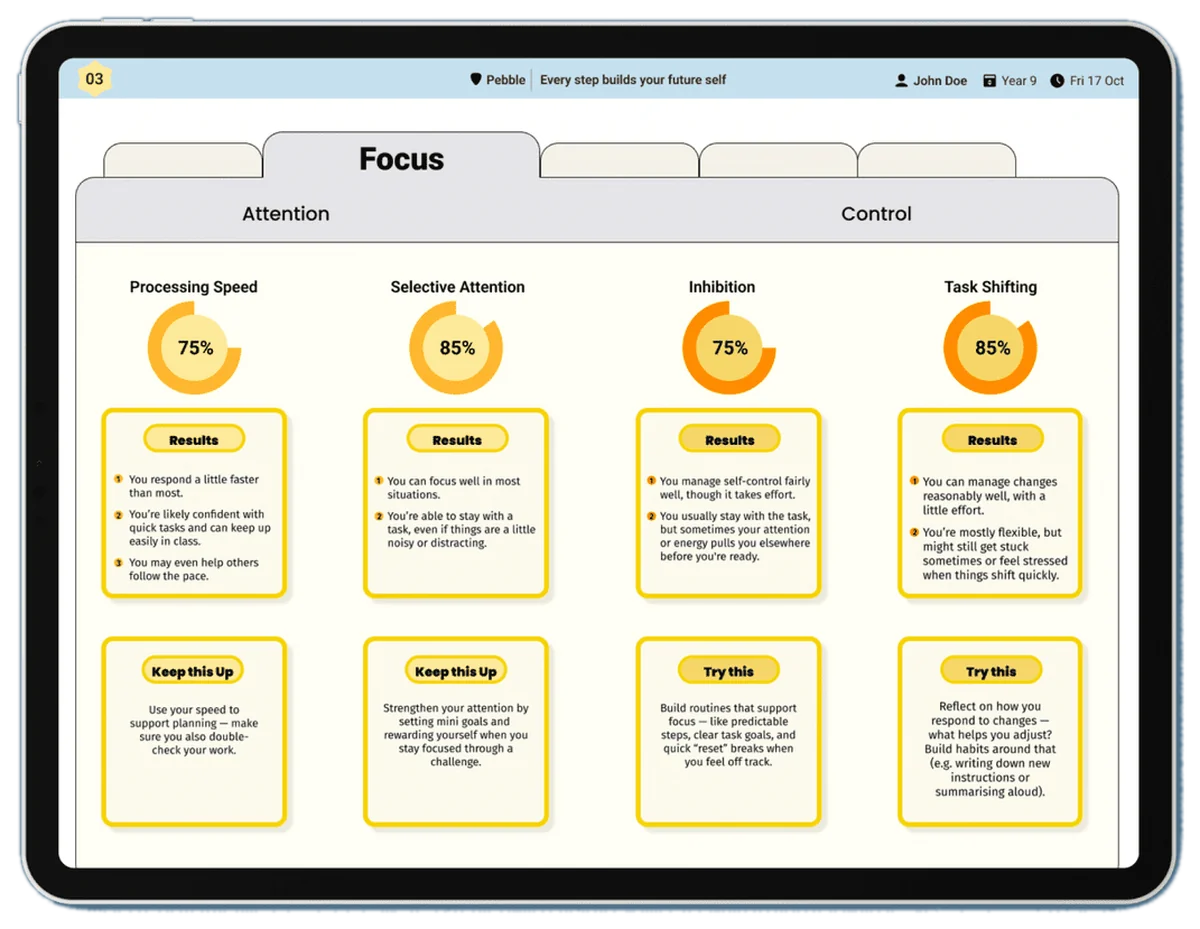
- Processing speed
- How fast and accurately a student responds to information.
- Selective attention
- How well they deal with distraction.
- Inhibition
- Holding back an impulse to meet a goal.
- Task shifting
- Switching focus between tasks.
What helps in classSlow the pace and allow longer to process. Seat the student away from distractions and cut clutter. Split the task into clear chunks, and keep changes of activity to a minimum.
Thinking
When the task asks too much at once
You might see a student who loses track halfway through, cannot get started, or gives up on a multi-step problem before trying. Disengagement becomes a way of protecting themselves from overload.
- Working memory
- Holding information in mind and working with it.
- Planning
- Thinking ahead before starting.
- Deductive reasoning
- Solving problems logically.
- Visuospatial abilities
- Manipulating objects in the mind.
What helps in classGive one instruction at a time and break tasks into smaller steps. Reduce how much students must juggle at once, and offer planning scaffolds such as a worked example or a checklist.
Memory
When information does not stick
You might see a student who says “nothing goes in”, forgets instructions given aloud, or cannot recall last lesson's work.
- Verbal memory, immediate
- Learning new verbal information.
- Verbal memory, delayed
- Remembering it later.
- Visuospatial memory, immediate
- Learning visual information.
- Visuospatial memory, delayed
- Recalling it later.
What helps in classWrite key steps down as well as saying them. Pair words with clear visuals. Build in short recall tasks, so learning is retrieved, not only re-read.
These are structural adjustments, not motivational fixes.
A note on learning styles
Memory differences are not “learning styles”. Research has not found that teaching to a student's preferred style helps them learn. What does differ is how well a student learns and recalls what they hear, compared with what they see.
A student whose verbal memory is weaker than their visual memory may lose spoken instructions, so writing them down helps. Pairing words with visuals helps most learners, and gives that student a second way in.
Why it matters
When disengagement is misunderstood, support becomes generic. When the cause is clear, support can be precise. A student with slow processing speed needs a different adjustment from one whose working memory fills quickly, and a student thrown by changes of activity needs something different again.
The purpose of a cognitive assessment is not to label students. It is to understand what sits behind the disengagement, so the right support arrives sooner.
How Veyra measures the three areas
Veyra: Mind Skills Check measures all 12 skills in one lesson. Pupils play 12 short game tasks, each with a tutorial and a practice round, and there is no pass or fail. The whole class appears in the Teacher Dashboard with strategies teachers can use straight away. For the pupils who need more, a Student Report shows their results area by area, with a strategy to keep doing or to try for each skill (Fig. 1).