In brief
- Support should arrive early, as standard, without families having to fight for it.
- That needs two things: a clear view of each student's needs, and a practical way to act on them in class.
- Veyra works at the universal and targeted end. It is not specialist provision.
What the reforms ask for
In February 2026 the Department for Education published Every child achieving and thriving, a white paper on the schools and SEND systems in England, with a consultation on SEND reform alongside it. Its central idea is simple: support should arrive early, as standard, without families having to fight for it. The five principles behind it (Early, Local, Fair, Effective and Shared) all point the same way.
For schools, that means a few concrete shifts:
- Layers of support. Most needs are met through a universal offer of high-quality, inclusive teaching, with targeted and specialist support above it. Education, health and care plans stay, for the most complex needs.
- Early, accurate identification. The model only works if schools can see a student's needs before difficulties harden into disengagement, absence or crisis.
- Individual Support Plans. A digital record of what a student needs, what was tried and how they responded, reviewed regularly.
- National Inclusion Standards. A clearer baseline for what every school provides, with Ofsted giving more weight to inclusion.
- Staff capability. More SEND training for school staff.
When this was written, these were proposals, not law. The consultation closed on 18 May 2026, and existing SEND law still applied. Schools should treat the reforms as a direction to prepare for, not an overnight switch. Read the white paper on GOV.UK.
Where the gap is
Asking mainstream schools to identify and meet more needs, earlier, with fewer statutory plans, is the right instinct. It only works if schools have a way to see each student's needs in the first place, and a practical way to act on them within ordinary teaching.
Early identification is hard to do well at scale. A capable, well-behaved student who struggles to hold instructions in mind, or who processes information slowly, can go unseen for years. A teacher's professional judgement is irreplaceable, but it should not have to work without good information.
And once a need is found, targeted support has to mean something specific, not a vague intention in a plan that no one has the time to follow through.
Where Veyra fits
Veyra is built by a team with clinical and research backgrounds. It is developed with Innovate UK and Bournemouth University, and funded by UK Research and Innovation. It works at the universal and targeted end of the new model, where most pupils' needs will be met.
- Universal
- Veyra: Mind Skills Check. Each class takes 12 short tasks in a normal lesson, led by its own teacher, and a year group runs class by class. Every pupil is measured the same way, before anyone has fallen behind, and the pupils who need a closer look are flagged.
- Class level
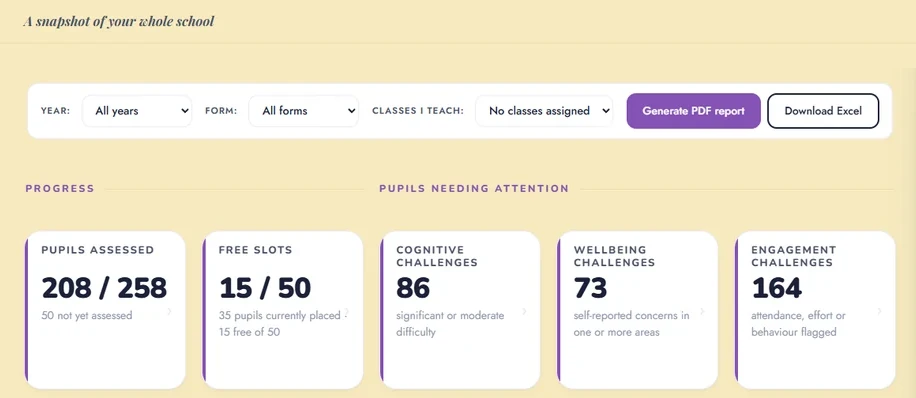
- Veyra: Teacher Dashboard. Whole-school, year-group and class views, with strategies teachers can use in the next lesson, and PDF and Excel exports for leaders and governors.
- Targeted
- Veyra: Student Reports. For the pupils who need more, chosen by the school: a profile and action plan, an export to the pupil passport or support plan already in use, and a report for parents. A clear starting point for an Individual Support Plan.
- Evidence over time
- A termly re-check. Each pupil receiving more support is checked again every term, so the plan records progress, not impressions, and the school can show its support is working.
- Staff confidence
- Onboarding and free CPD. We set it up with you and support the first session, and termly CPD sessions, held online, help staff read the results and use the strategies.
- Coming soon
- Veyra: Pebble Academy. A training game that will build the skills each pupil's Skills Check flagged, as part of the support for pupils who need more.
Veyra is not a replacement for specialist provision, and never claims to be. Students with the most complex needs need expert, individual support, and the reformed EHCP route rightly protects that. It is not a diagnosis either. It gives schools evidence to act on sooner, and to support a referral when one is needed.
What to do now
The schools that handle this change best will be the ones preparing now: reviewing their SEND provision, strengthening early identification, and building the habit of recording what was tried and how each student responded. None of that has to wait for legislation.